
Love Story Dorian & Finn
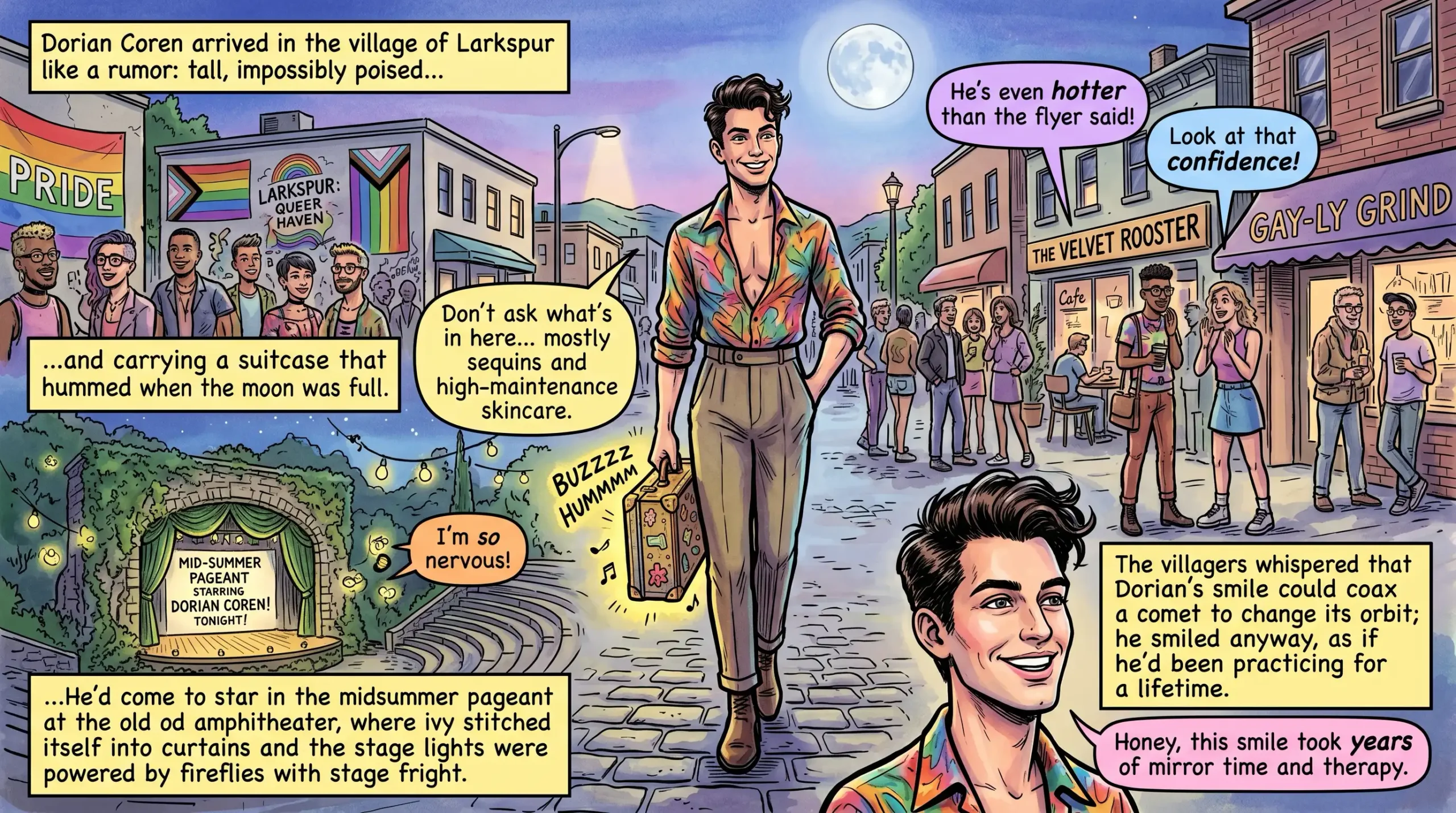
Dorian Coren arrived in the village of Larkspur like a rumor: tall, impossibly poised, and carrying a suitcase that hummed when the moon was full. He’d come to star in the midsummer pageant at the old amphitheater, where ivy stitched itself into curtains and the stage lights were powered by fireflies with stage fright. The villagers whispered that Dorian’s smile could coax a comet to change its orbit; he smiled anyway, as if he’d been practicing for a lifetime.
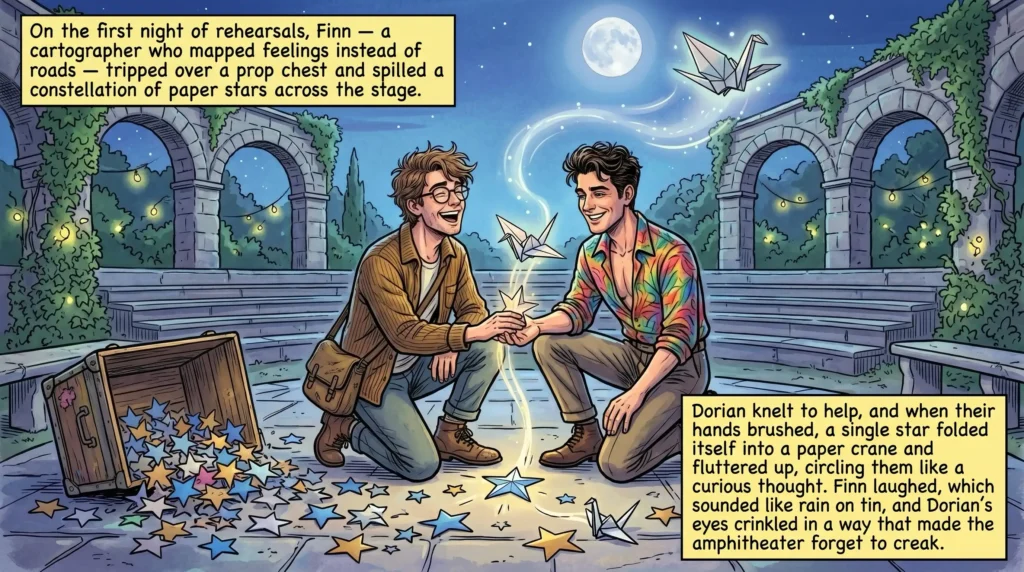
On the first night of rehearsals, Finn — a cartographer who mapped feelings instead of roads — tripped over a prop chest and spilled a constellation of paper stars across the stage. Dorian knelt to help, and when their hands brushed, a single star folded itself into a paper crane and fluttered up, circling them like a curious thought. Finn laughed, which sounded like rain on tin, and Dorian’s eyes crinkled in a way that made the amphitheater forget to creak.
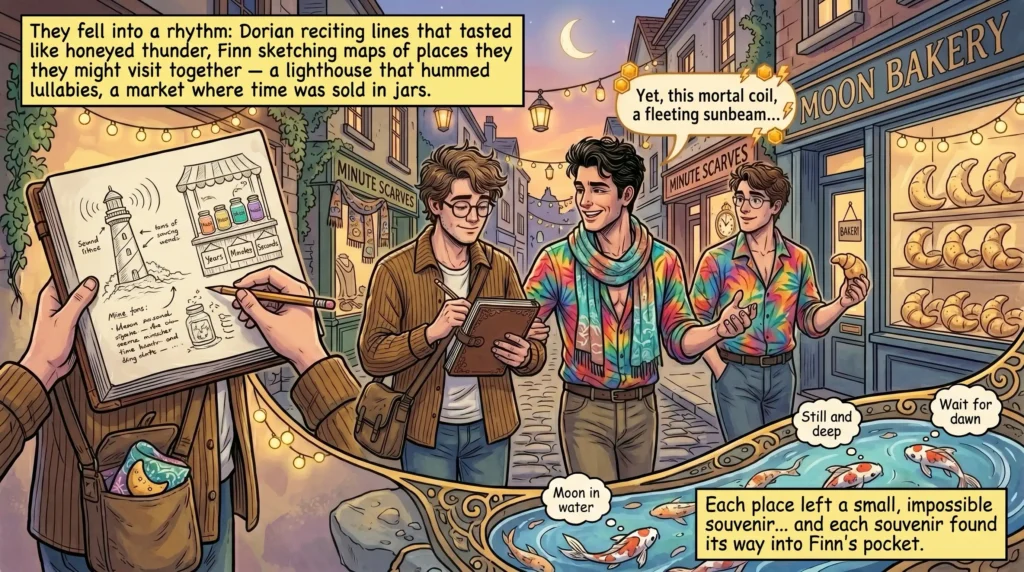
They fell into a rhythm: Dorian reciting lines that tasted like honeyed thunder, Finn sketching maps of places they might visit together — a lighthouse that hummed lullabies, a market where time was sold in jars. Between rehearsals they wandered the town’s oddities: a bakery that sold croissants shaped like crescent moons, a clockmaker who stitched minutes into scarves, and a pond where koi read poetry aloud. Each place left a small, impossible souvenir — a pastry that remembered your childhood, a scarf that smelled like the sea — and each souvenir found its way into Finn’s pocket.
Queer Romance Story
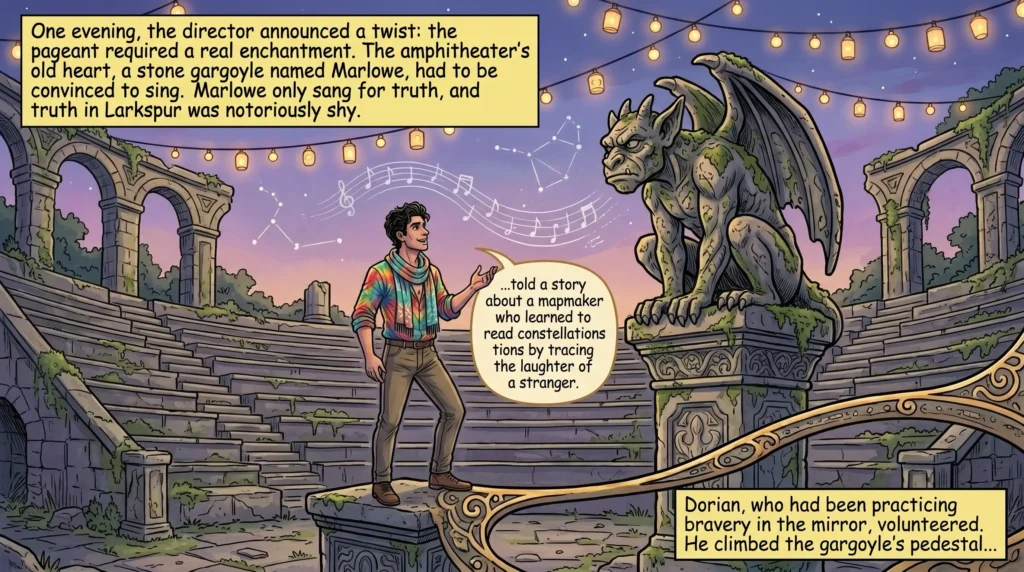
One evening, the director announced a twist: the pageant required a real enchantment. The amphitheater’s old heart, a stone gargoyle named Marlowe, had to be convinced to sing. Marlowe only sang for truth, and truth in Larkspur was notoriously shy. Dorian, who had been practicing bravery in the mirror, volunteered. He climbed the gargoyle’s pedestal and, under a sky freckled with lanterns, told a story about a mapmaker who learned to read constellations by tracing the laughter of a stranger.
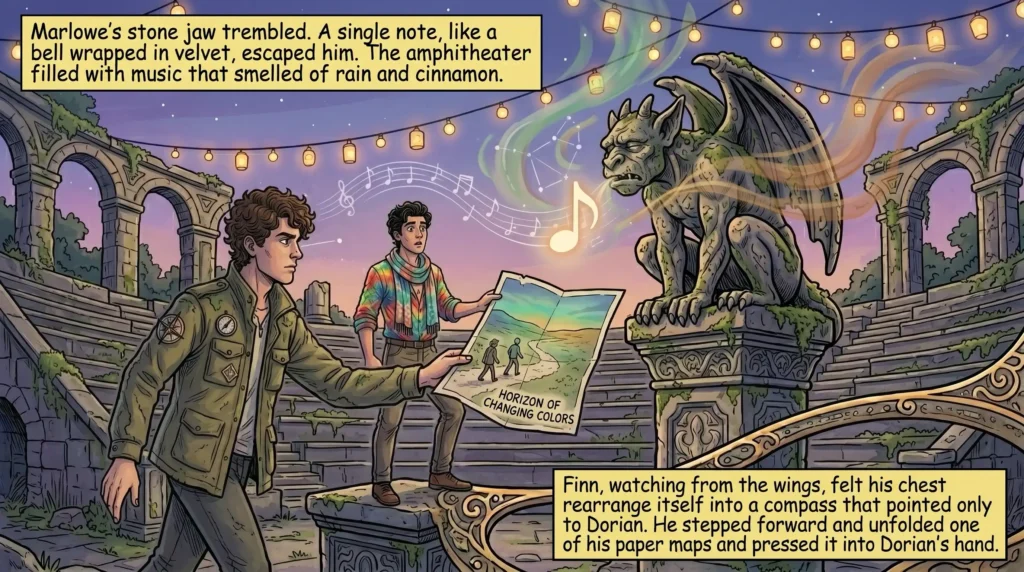
Marlowe’s stone jaw trembled. A single note, like a bell wrapped in velvet, escaped him. The amphitheater filled with music that smelled of rain and cinnamon. Finn, watching from the wings, felt his chest rearrange itself into a compass that pointed only to Dorian. He stepped forward and, without thinking, unfolded one of his paper maps and pressed it into Dorian’s hand. The map had no roads — only a tiny drawing of two figures walking toward a horizon that kept changing colors.
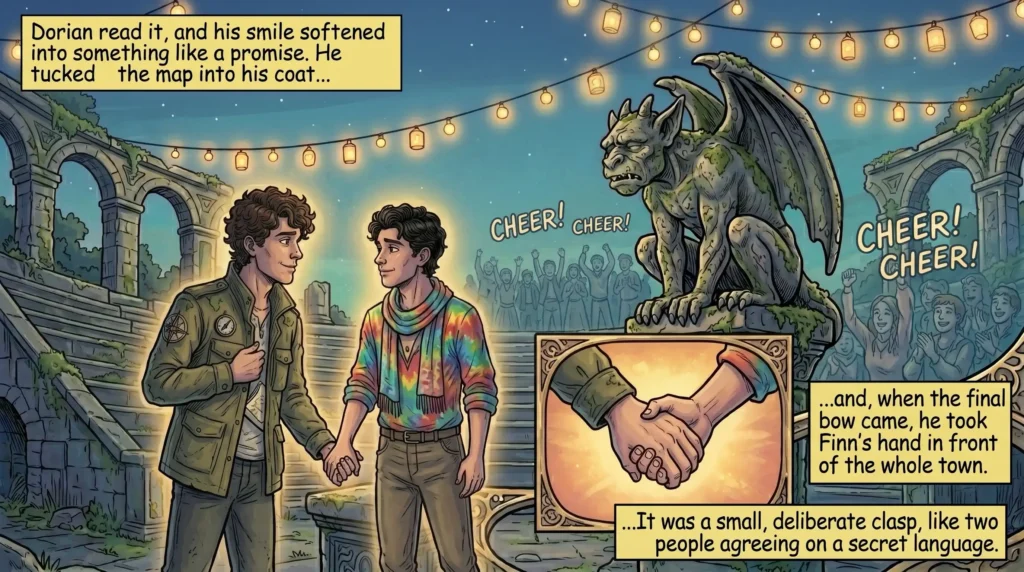
Dorian read it, and his smile softened into something like a promise. He tucked the map into his coat and, when the final bow came, he took Finn’s hand in front of the whole town. It wasn’t dramatic; it was a small, deliberate clasp, like two people agreeing on a secret language. The crowd cheered, but the sound was distant, as if they were underwater and the only thing that mattered was the warmth between them.
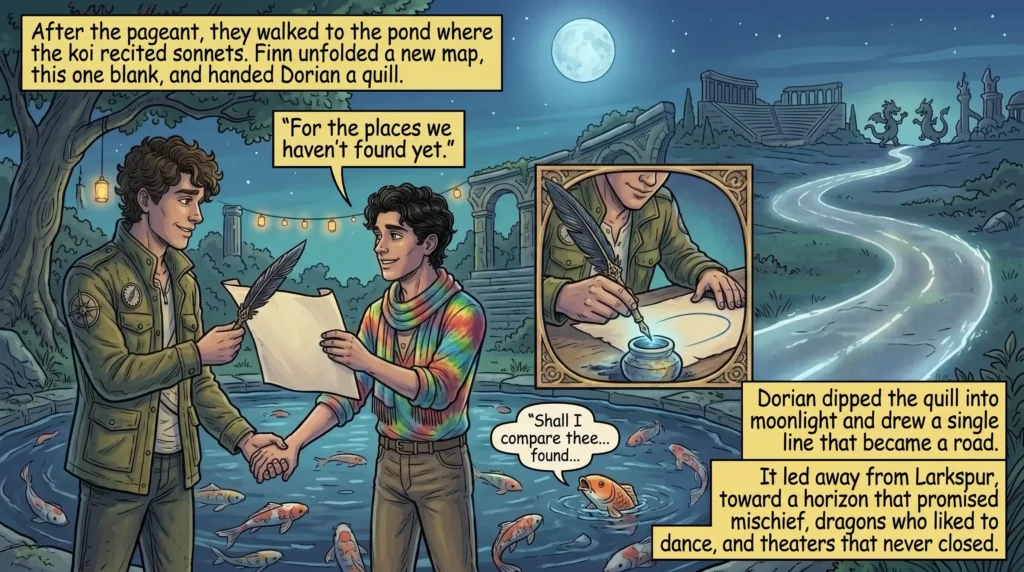
After the pageant, they walked to the pond where the koi recited sonnets. Finn unfolded a new map, this one blank, and handed Dorian a quill. “For the places we haven’t found yet,” he said. Dorian dipped the quill into moonlight and drew a single line that became a road. It led away from Larkspur, toward a horizon that promised mischief, dragons who liked to dance, and theaters that never closed.
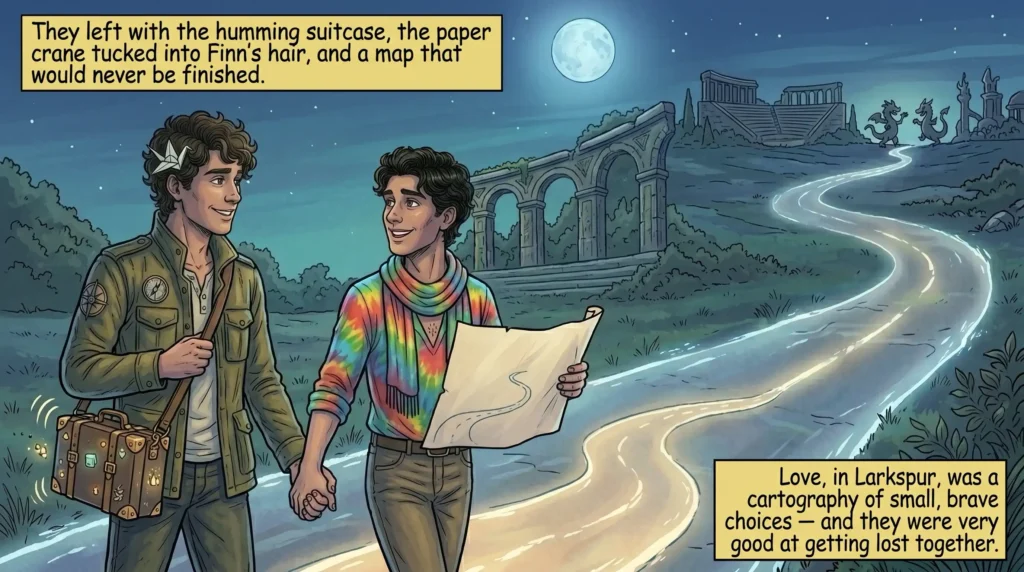
They left with the humming suitcase, the paper crane tucked into Finn’s hair, and a map that would never be finished. Love, in Larkspur, was a cartography of small, brave choices — and they were very good at getting lost together.